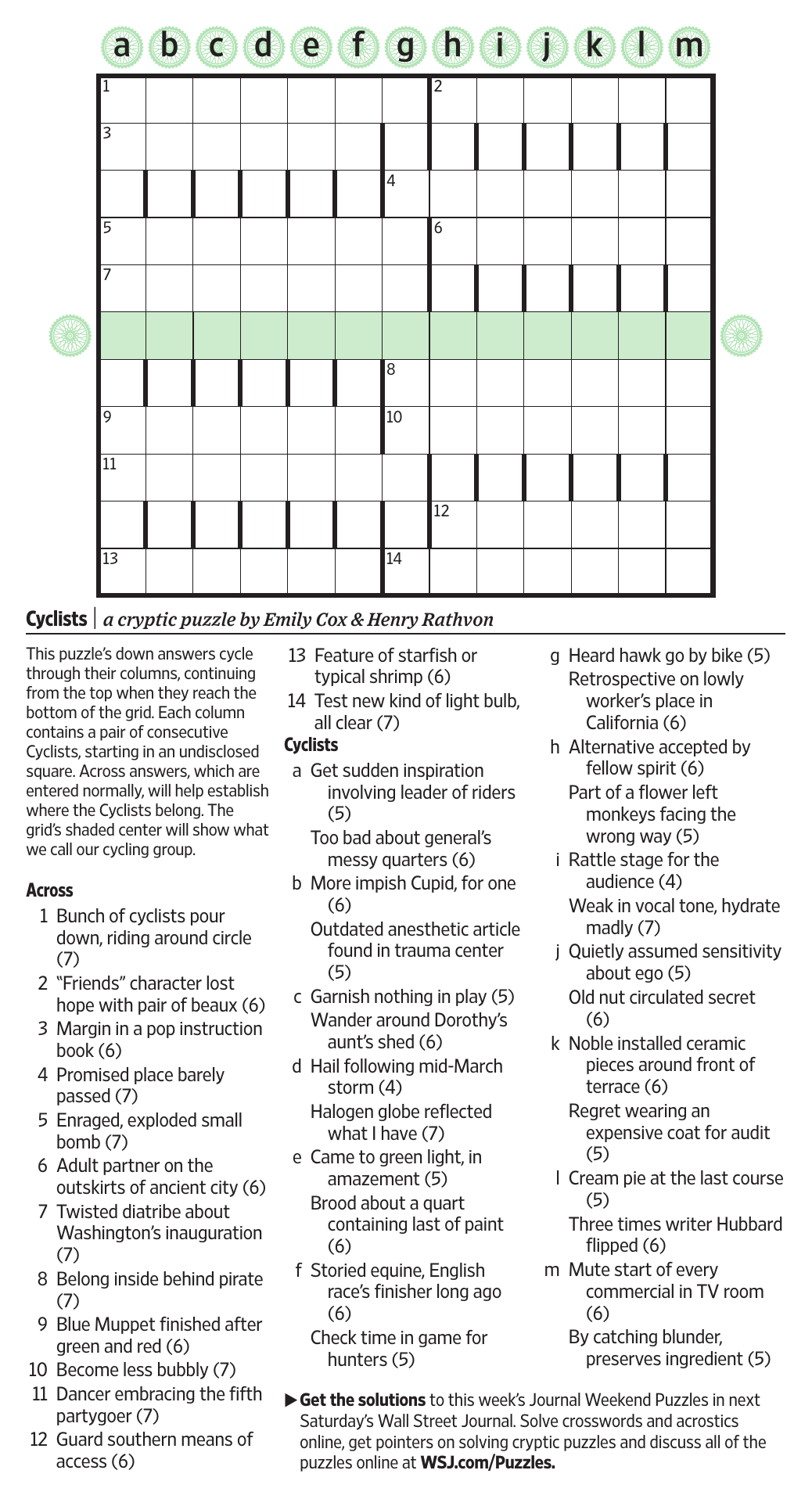
Cyclists: walking through the solution of a cryptic puzzleFirst see “Cryptic Clue-Solving for Beginners,” which Emily Cox and Henry Rathvon provided with their first cryptic puzzle in The Atlantic, September 1, 1977. They describe 8 devices:
A cryptic puzzle is often very slow going at first, and then as more of it is filled in, solutions (answers or entries) come more easily. There are generally two parts to every cryptic clue:
In addition, there is often an auxiliary part, a signal word or indicator that suggests the kind of wordplay to be used. The first challenge is to determine what is the definition part, which may require some trial and error, i.e., seeing if the rest of the clue provides the cryptic clue to the solution. Sometimes they are separated by words like “is,” “with,” “for,” “from,” and “and,” but those words may well be used in other ways in the clue instead. “Has” and “gets” may indicate parts of the cryptic clue, much as “+” might. Remember, as noted below, to ignore punctuation and sentence structure, because they are generally misleading. The second step is to look for a signal of the device to be used. Again, the clue may be written deceptively. What may look like a signal word may not be, and vice versa. It is usual to indicate the length of the solution in parentheses after the clue. If it is more than one word or hyphenated, the lengths of the parts may be provided, e.g., “3,5” or “6-2.”. Where a square is shared by 2 answers, each answer is “checked” by the other. A checked square filled in by one answer can help to solve the crossing answer, or “light.” Sometimes, as Cox & Rathvon note, the devices may be combined or varied in some way, which is generally indicated by a question mark or an exclamation mark, which indicates that the clue has some other quirk, for example, “Dull month for stutterers? (6)” (answer: “jejune” (“dull”)), “I can be found in the classroom! (12)” (answer: “schoolmaster” (not cryptic at all)), “Beantown? (4)” (answer: “lima”), and “Eccentric with freckles?” (answer: “dotty”). Sometimes, the clue must be read as a direction, often indicated by “must,” for example, “Man must cover part of the body with clothing (7)” (answer: “garment” (G(ARM)ENT: gent (man) “covers” arm (part of body))). Again, as Cox & Rathvon used to remind solvers, punctuation in the clues may be used deceptively. Or as Stephen Sondheim before them said in his puzzle instructions in New York Magazine, “Ignore pumctuation, which is designed to mislead” (or “confuse,” Richard Maltby, who provided some examples of re-punctuation, later put it). Even hyphens may be deceptively used, for example, “Foot-holds concerning a network (4).” This can be reparsed as “Foot holds concerning: a network,” and the answer is “fret” (“re” held by “ft”). Phraseology, too, is almost always misleading. What looks like a meaningful sentence should not be seen as such. For example, “Small things I like to upset inside (4).” Tha answer is “iotas,” “I” plus “like” (i.e., as) with upset “to” inside. Or, “Father-to-be (third person, dialect) (6)” needs to be read as “father” plus “to” plus “be, third person” for a word meaning “dialect”, i.e., “pa-to-is.” And “Wood almost links warnings (5),” the answer being “fores,” i.e., “wood (‘forest,’ almost): links (golf course) warnings.“ Also, each puzzle may have its own theme and added devices or required adjustments (of the answers, for example) for completing it. The instructions must be read very carefully. This is a hallmark of Cox & Rathvon’s puzzles, which are sometimes called “variety cryptic.” In the present example, Cyclists, there are no down clues per se, but instead 13 continuous loops of 2 words in each column, called “cyclists,” but it is not indicated where they start. Furthermore, the center row will spell a related answer, “what we call our cycling group.” As the latter fills in, you may guess what it is, which in turn will help you complete the “cyclist” clues. On to the puzzle!
Click here for a PDF to print out. In my experience, anagrams are the easiest to spot, because of words like “exploded” in 5A: The answer is 7 letters long, and the word “enraged” is 7 letters, so we can see if it is an anagram for the definition “small bomb.” The answer is yes: “grenade.” (As noted in Cox & Rathvon’s guide, other words that may indicate an anagram include “changing,” “new,” “reforming,” “wild,” “bad,” “confused,” “drunk,” “out” (for “out of order”), and even “possibly,” “could be,” and “perhaps.”) One way to look at possible anagrams is to first shufffle the letters so that they no longer make up the word or phrase in the clue and it’s easier to see them more randomly. One way is to write down every odd letter and then back with every even letter. For example, “Ruffled pleat rose, in part” suggests an anagram of “pleat” to mean “rose, in part.” Rearranging the letters (odds, then evens back) gives “petal”! With that “light” (the solution entered in the grid) in place, we can see to others above and below it that might help filling in the columns that cross it. In 7A, “Washington’s inauguration” suggests nothing more than the letter “w” (the start of the word). “Twisted” suggests an anagram, but the solution is 7 letters and “diatribe” is already 8, and would be 9 if “w” is inserted. So perhaps “twisted” is the definition, and a word for “diatribe” with “w” inserted would provide the solution. And so the answer is “screwed” (“screed” with “w”: SCRE(W)ED). 9A seems to require a knowledge of children’s television, but we can guess that it’s a name that begins with “gr” (”green and red”) followed by (“after”) a word for “finished,” such as “over”. And so the answer is “Grover.” The other across clues are more ambiguous at this point, so let’s see if we can fill in any of columns a to g with the help of the three lights we’ve filled in. In cyclist b, the first clue, after pondering it a while, appears to be a double definition: “more impish” and “Cupid, for one.” The answer is “archer.” In the second clue, a 5-letter solution for the definition “outdated anesthetic” readily suggests “ether,” so you need to see if the rest of the clue points to that. “The” is indeed “article,” and it is found in “ER,” i.e., emergency room for “trauma center.” It then remains to determine where in column b to place these 2 lights. You have “RC _ _ R,” which fits “archer,” and “ether” then starts right below it and wraps around to the top. In the second clue of cyclist c, the “’s” may mean “is” instead of indicating possession (“Dorothy’s aunt,” but not her “shed”), which would mean that “shed” is likely the definition. The possible misdirection of possession suggests a noun, but remember that “shed” is also a verb, and it may be either present or past tense. “Dorothy’s aunt” is obviously “Em.” Is there a word for “wander” that we can put “around” “em” to mean “shed”? Yes: “rove” — insert “em” to get “remove.” With the across lights that we have, however, “remove” can fit in two places, so we need more lights before we place it. Moving on to cyclist d, “hail following mid-March” appears to use a “bits and pieces” device, “mid-March” being “r.” (But always keep an open mind: it could mean “ides.”) So we may be looking for “r’ followed by a word meaning “hail“ to mean, together, “storm.” The answer is “rave” (R+AVE). But we need the second light to know where to place it, and that one is not readily obvious, and at this point, you don't need to fret over it. In the first clue of cyclist f, consider that “English” may be used to indicate simply E (abbreviation) and “race’s finisher” may also be simply indicating E (bits and pieces), so a “storied equine” that begins with “ee.” “Long ago” provides “yore”: “eeyore.” But again, the second clue is required to be sure about the placement. In the first clue of cyclist g, “heard” suggests a homonym, which would be for “hawk” and “go by bike.” We can hear “peddle” (“hawk”) when we say the answer, “pedal.” In the second clue of cyclist g, “retrospective” suggests a reversal device, and again, the “’s” suggests that “place in California” is the definition. So the solution would be a reversal of “on lowly worker.” After a little pondering, “lowly worker” might be “serf” (remembering that the solution is 6 letters), so a reversal of “on serf” is “Fresno.” Because there is no “d“ in “fresno,” you can place “pedal” in the column and thence “fresno.” Now that you have a couple of columns filled in, look back over the cross clues, which may be easier to solve with the one or two letters provided. 11A may be using an abbreviation device, with “the fifth” indicating V (as in designations of kings and queens). If so, can you think of a kind of “dancer” that could be converted to mean “partygoer” if “v” is inserted? Of course: “reeler,” for the solution “reveler.” (V, of course, is the Roman symbol for 5, as I is for 1, X 10, L 50, C 100, D 500, and M 1,000. Note that 1,000 may also stand for K (“kilo”) and, particularly when relating to money, G (“grand”). Remember that they can be combined, for example, IV may be represented by 4, VI by 6, CL by 150, MD by 1,500, etc. V may be signified by other clues, of course, such as “sign for peace.” “One,” on the other hand, may signify “a” or “an,” and vice versa, either the letters “one” or “i.” “A” may also appear to be used as an indefinite article in the clue, but is in fact there as part of the solution, for example, the clue “A female is imperfect (5)”: answer “amiss.”) In 13A, the words “feature of” suggest a possible camouflaged clue. Is there a word in “starfish or typical” that means “shrimp”? Yes: “shorty.” With those 2 across lights filled in, check back with cyclists c, d, and f. In c, there is now only one place for ”remove”: starting at the “r” in the cross clue “screwed.” In d, we still don’t have enough to place “rave.” And in f, there is now only one place for ”eeyore”: starting at the third “e” in the cross clue “reveler.” You now have only 2 letters missing for the other part of cyclist f: “de _ _ r.” “Time” is often used to signify “t,” as in a scientific or mathematic equation. So it might go “in” “game for hunters,“ which “de _ r” is readily seen to be “deer.” Insert “t” for “deter” as answering the definition “check.” None of these further help very much with the solutions of 1A and 3A, however, so let’s move on to the other side, columns g to m, starting with the across clues. 2A might be an anagram in part: “lost” possibly suggesting an anagram of “hope.” But that’s only 4 letters, and the solution is 6, so “with a pair of beaux” sounds helpful, i.e., add “be” to a rearrangement of “hope.” Whether you know the television show ”Friends” or not, you might guess the name “Phoebe,” which, if you’re not sure, you can confirm as the crossing column fill in or, of course, by looking it up. (Remember that quotation marks and capitalization might be used deceitfully in a clue, although they were not in this case.) In 8A, “inside” suggests a container device: “belong inside behind” as the cryptic clue for “pirate.” If “behind” is “late” (we already have the “l”) and “belong” is “fit,” then we can form the pirate “Lafitte.” (“Without” can similarly suggest a container device, but it may also suggest bits and pieces.) 10A is a short clue. Clues of only two or three words are mostly likely double definitions. So fish around in your mind for a word that begins with “f” (which we already have from cyclist g) that means both “become” and “less bubbly.” The solution is “flatter.” In 11A, “southern” most likely simply provides an “s” (abbreviation device) for the solution: “s” plus “means of access” to mean “guard”? Yes: “sentry.” In 14A, “new” suggests an anagram (of “test”), and it would be followed by “kind of light bulb” to make a word meaning “all clear.” Because the solution is 7 letters, and “test” is 4, “kind of light bulb” would be 3 letters: perhaps “LED.” The letters of “test” can be rearranged before that to arrive at “settled.” (Often, as in this case, the definition is a bit loose or less usual in relation to the solution. Always keep an open mind. Metaphor may also be involved, for example, “little pig” to signify “toe.”) With five across lights now in place on the on the right side of the puzzle, try solving the columns now, cyclists h to m. In the second clue of cyclist h, “facing the wrong way” suggests a reversal, and the “sep” available suggests a reversal of “apes” for “monkeys.” “Left” is another word that can signify simply L (by abbreviation, as “right” would signify R, “east” E, etc.). (Note that “left” may also suggest reversal, similarly to “back” or ”from behind.” but that would not apply to a vertical light, as in this case. For vertical lights, reversal may be suggested by words like “rising” and “up”) So “left monkeys“ would be “lapes,” which “facing the wrong way” would be “sepal,” which is indeed “part of a flower.” (Some other abbreviations to be aware: “quiet” or “soft” for P (“piano” in music) and “loud” (and similar words) for F (“forte” in music”); also from music, “note” for DO, RE, etc., or one of the letters from A to G, or “sharp” or “flat”; elements, such as “copper” for CU, “gold” for AU; “large” for L and “small” for S; “true” for T and “false“ for F. The Globe & Mail has an extensive list.) But there are two “al”s in the column, so you can’t place “sepal” until you solve the other clue in this column. In the first clue of cyclist i, “for the audience” suggests a homonym, in which case you would need to think of a word meaning “rattle” that sounds like “stage.“ And that would be “faze” (“phase”). The column seems ready for it at “fa _ e,” but it could fit elswhere, so you should make sure of the other clue first. In the second clue of cyclist i, “madly” suggests an anagram, and “hydrate” is 7 letters, matching the length of the light. Can it be rearranged into a word meaning “weak in vocal tone”? Yes: “thready.” So column i can be filled in. An anagram is suggested also in the second clue of cyclist j by “circulated.” The light is 6 letters, and both “old nut” and “secret” are 6 letters, so you have to determine (assuming an anagram) which is the definition and which the cryptic clue. “Old nut” seems less likely to be the definition, and indeed, it can be rearranged into “untold,” meaning “secret.” Even without the other clue, there is only one place it can go in column j: starting at the bottom and wrapping around to the top. In the first clue of cyclist k, “front of terrace” suggests simply “t” (bits and pieces). “Ceramic pieces” could be “tiles,” and putting it “around” “t” gives you “titles,” which is related to “noble” but not quite. The remaining word, “installed,” resolves the clue: “installed ceramic pieces,” i.e., “tiled,” and with “t,” “titled.” And again, the other clue of cyclist k is not needed to determine its placement. (Here's another example of bits and pieces, which merits its own device category, namely, “deletion”: “Scopes’ lawyer loses fight but gains victory for me! (6).” “Scopes’ lawyer” is “Darrow,” and it “loses fight,” i.e., “row,” “but gains victory,” i.e., “win.” The exclamation point signifies that it is not a straight definition, so that “for me” refers to rather than defines the solution, which is “darwin.” (This example shows that “I” and “me,” also “it,” “this,” and “that,” and perhaps “what” and even “here” and “there,” may be used to refer to the solution itself.) (Another variation that it seems has not merited its own label, is directional, for example, “Little ass has love for a big ass? (4).” This looks like it involves a container (“has love”), but a solution does not suggest itself that way (what is a “little ass” in which inserting “a” would form “a big ass”?) Instead it has elements of both bits and pieces and double definition. To be honest, I don’t know why the question mark is used, unless to suggest an atypical device, which is directional. “Love for a” directs you to change “a” in the first definition to “o” to get the second definition: “foal” to “fool.”) Scanning through the next cyclist clues, “for audit” suggests a homonym in the second clue of cyclist k, and “flipped” suggests a reversal in the second clue of cyclist l, but solutions may not come readily to mind at this point. In the first clue of cyclist m, “TV room” suggests “den” and “commercial” suggests “ad, which “in” the former suggests “deaden” for “mute.” The “e” is suggested by “start of every.” Thus, the definition is “mute” and the cryptic clue is “start of every” plus “commercial” ”in” ”TV room”: D(E+AD)EN. Again, the other clue of cyclist m is not needed to determine its placement in the column. The light for the second clue of cyclist m is now “_ er _ y,” and “preserves ingredient” would certainly be “berry.” This is an example of filling in the light according to the definition and letters already provided before solving the cryptic part of the clue. To confirm, “by catching blunder” does indeed provide “by” “catching” “err”: B(ERR)Y. So now, with some of letters provided by the cyclists, you can go back to 4A and 6A. But you may still need more hints, as 4A remains rather cryptic and 6A is not yet clear about definition and cryptic. Again, there is no need to fret over them yet. At this point, you might look at the center row to see if its solution is taking shape. At the least, with “_ he” at the beginning, it probably starts with “the.” So see if that helps solve either of the clues of cyclist a. Or review cyclists c to e. In the first clue of cyclist a, “nothing” likely signifies “o,” and there is an “o” at the bottom of column c. It’s after the already solved clue, so is there a 5-letter word for “garnish” that starts with “o” and ends with something (4 letters long) that means ”in play”? Yes: “olive.” (Another, not so obvious indicator of “o” is “love,” as the latter is used, for example, in tennis, to signify 0. Words like “circle,” “ring,” “donut,” and “bagel” may also be used to signify “o.”) For the unsolved second clue (7 letters) of cyclist d, depending on where the first light is placed, we have “_ r _ _ _ ne” or “ne _ _ ve _.” “Globe” may signify “o” or it may mean “globe,” which is more likely if it is “reflected,” unless it is “halogen globe” that is reversed. If the latter is the case, then the definition would be “what I have.” Halogens are a class of element, such as chlorine and fluorine. What if “halogen” is the definition? One of the possible lights ends in “ne,” so that is a possibility. You may have to look up other halogens, or with the hint of “ine” for “what I have,” it might end with “mine.” And then you might think of “orb” for “globe,” reverse it, and voila: “bromine.” With that placed, you can also place “rave” from the first clue of cyclist d. Looking at the letters in column e and the clues of cyclist e, you might see “awoke” (“as _ _ e” is in the column) when you read “came to” in the first clue. If that is the definition, does it fit the cryptic clue? “Green light” could be “OK,” and it is “in” amazement, or “awe”: AW(OK)E. Now you might see a possible solution to the center row, with “(t)he rota – y – – – b”: “The Rotary Club.” With that all in place, does it help in solving or completing cyclists h, j, k, and l? In column h, you can now confidently place “sepal,” leaving “_ _ ral _” for the first clue of cyclist h. Can you think of any word fitting that with any of the words in the clue as the definition? Maybe not yet. In column j, the light for the remaining first clue of cyclist j is “_ _ cit.” Does any word come to mind that fits that light as well as any of the words in the clue as definition (or any parts of the clue as cryptic clues)? Maybe “tacit” for “quietly assumed.” Yes, that works: “tact” for “sensitivity” “about” “I” for “ego”: TAC(I)T. In column k, the light for the remaining second clue of cyclist k is “_ _ _ lt.” Follow the same questions as for the first clue of cyclist j, and you may think of “guilt” for “regret.” And the rest of the clue for the cryptic part? As noted earlier, “for audit” suggests a homonym, which for “guilt” would be “gilt,” which suits “wearing an expensive coat.” The clues of cyclist l remain elusive, so check on the remaining across clues. 4A is now almost completely filled in as “pledg _ d,” and so it must be “pledged.” That fits “promised” as the definition. For the cryptic clues, “place” seems to signify simply “pl,” leaving “edged” for “barely passed”: PL+EDGED. 6A is now filled in with “_ atu _ e,” in which you might see “mature” for the definition “adult.” the cryptic clues would then be "partner" with “ancient city” inserted (“on the outskirts of”): MAT(UR)E. Back in the first clue of cyclist h now, the light is “m _ ral _,” in which “morale” would appear to fit the definition “spirit.” In this case, you have to take “alternative” to signify “or,” which leaves it to be “accepted by” “male” for “fellow”: M(OR)ALE. Back to cyclist l, with a little staring at the letters provided in column l and back at the words of the clues, you might see “route” for “course” in the first clue. Does it work with the rest of the clue as cryptic clues? Yes: “rout” for “cream” and “e” for “pie at the last” (i.e., the last letter of “pie”). That leaves “_ reb _ e” for the second clue. Not many words could complete that, and “treble” fits “three times” as the definition. “Writer Hubbard” must be “Elbert” (which was “flipped”), whether you've heard of him or not. Back on the left side, with cyclists in mind, 1A (“_ elo _ on”) looks like it should be “peloton,” which word you may know as a brand of exercise bicycle, and maybe without looking it up as the word used for the central pack (“bunch of riders”) in the Tour de France. And the cryptic clues for it? “Circle” seems to provide one of the “o”s, and “riding around” it would be “pelt on.” “Pelt” would come from “pour down,” but what about the “on”? It would have be from “riding,” as in “on your bike,” so the cryptic clue is “pour down” (plus) “riding” “around” “circle”: PEL(O)T+ON. Only one across clue is left unsolved now: 3A, “_ rim _ r,” which “instruction book” suggests as “primer.” “A pop” can be “per,” and “margin” “in” it can be “rim”: P(RIM)ER. And now only two columns remain to be completed. The light for the second clue of cyclist e is “l _ tte _,” for which “brood” suggests “litter.” For the cryptic clues, “last of paint” is “t,” leaving “liter,” which fits “about a quart” “containing” it. (In this case, “about” is not what signifies the container device. Note that “about” may also be used to signify the abbreiations “c” and “re”.) In the first clue of cyclist a, “leader of riders” may signify “r,” so the light for this clue may involve the letters in the column around “r”: “? gr _ ?.” Look at the letters before and after (and around to the top) and see if any word comes to mind that would fit part of the clue as definition or “sudden inspiration” around (“involving”) the “r.” (“Get sudden” doesn’t make much sense as a unit, so the definition might be just “get.” Eventually, you may see “gasp” and “grasp”. That leaves “p _ gst _” for the second clue of cyclist a. “Messy” might suggest an anagram, but one doesn't appear obvious. Instead “messy quarters” suggests “pigsty.” “General’s” must stand simply for “gs,” leaving “pity” for “too bad” “about” it: PI(GS)TY. Done! (Click here for the filled in puzzle.) Click here for another sample puzzle with the answers explained.) Click here for a similarly constructed puzzle with one more level of challenge.) Click here for another puzzle of similar difficulty, also with a little extra challenge.) |